⬤ The oil market is going through a massive shift. Developed countries are cutting back while emerging economies keep ramping up. The numbers show OECD demand peaked years ago and has been sliding downward, but the rest of the world just keeps climbing. This isn't a temporary blip—it's a complete restructuring of who's driving global oil consumption.
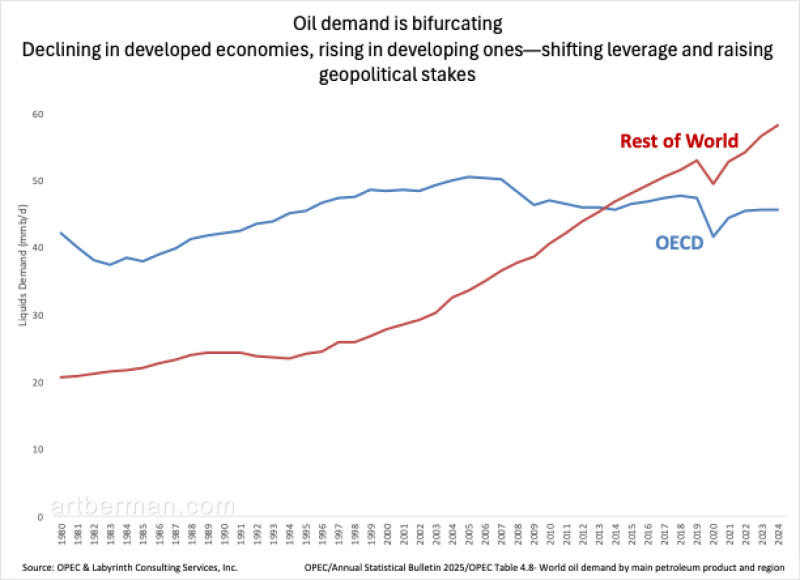
⬤ OECD countries saw their oil demand grow through the early 2000s before hitting a ceiling and dropping over the last decade. Meanwhile, non-OECD economies never stopped rising, really picking up speed after 2010. By the early 2020s, emerging markets overtook developed nations entirely. Today, developing economies are consuming significantly more oil than the OECD bloc, fueled by population booms, rapid urbanization, and industrial expansion.
⬤ This changes everything about market power. Growth is now concentrated outside advanced economies, which means disruptions or policy shifts in emerging regions have way more impact on global supply and demand. Since 2022, market volatility has increasingly tracked what's happening outside the OECD—proof that developed nations no longer call the shots on demand.
⬤ Here's why it matters: emerging economies are messier. They face more geopolitical chaos, weaker infrastructure, and unpredictable policy moves. As their share of global demand keeps climbing, oil markets become more vulnerable to regional blowups and political curveballs. The bottom line: the oil market's future is being written in developing countries, not Western capitals.