
 Edward Culchenko
US news. Last week in Cleveland the head of US Federal Reserve System (FRS) Ben Bernanke was rather critical about the White House policy and the government of other leading countries worldwide.
The inability of developed countries’ governments to implement key economic principles in practice encourages “to take several lessons”, as claimed by the FRS head, from such developed countries as China, India, etc. Moreover, B.Bernanke rather specifically indicated the directions in which economic giants should take after developing countries:
■rough fiscal discipline;
■free trade;
■state investments;
■education and science support.
WB predicts steady growth of economy in developing countries
Experts of Forex Academy and Masterforex-V Futures Trade and Stock Exchange remind that at the beginning of the year the World Bank (WB) predicted steady economic growth of developing countries in 2011-2012 and their prevailing input into world economic recovery:
■GDP growth. The growth of gross international product (GIP) in 2011 is predicted to reach the level of about 3.6%. It will amount to 2.4% of GDP growth in developed countries and to 6% in developing countries;
■forecasts of recognized organizations. WB predictions are proved by UNIDO, which has recently summed up the results of world economic development during the second quarter of current year. World industrial production has risen by 5.2% during April-June, which is much less than during the first quarter 2011, namely 7.4%. What is more, the results of the second quarter, as well as the forecasts for the current year, but it could have been much worse if it hadn’t been for the developing countries: thus, if during the second quarter US annual industrial production has risen by 4.4%, than in China, economic leader of developing world, – by 14.3%!
experts have discussed whether the role of developing countries truly is so significant in international economic development and how likely their rapid growth is.
What is the worldwide role of developing countries?
Average income is the primarily basis for dividing countries into developed and developing ones:
■ developed countries. Thus, developed countries include about 70 states worldwide, where average annual income amounts to $ 36.3 ths. Developed countries currently provide 60% of GIP, although only 17% of the planet’s population live on the territory of these countries:
- developed countries limit. However, if to eliminate those countries, whose high income is provided by raw material export (Saudi Arabia, Kuwait, etc.) or off-shore preferences (the Cayman Islands, Cyprus , etc.), the list of developed countries will include only 30 states, members of the Organization for Economic Cooperation and Economic Development (OECD);
■developing countries. The average annual income in one hundred developing countries amounts to $ 5.7 ths. 70% of world population, which lives in developing countries, provide 40% of GIP. Moreover, the rates of GDP growth in developing countries during the recent years have exceeded the equal criteria in rich countries three times. Higher rates of growth have enabled the developing countries to cut the gap between developed countries and themselves twice for the period of last 40 years: they currently correlate as 1 to 6.
G7 (Big Seven) currently stands against Е7 (Emerging Seven), which includes China, India, Brazil, Russia, Mexico, Turkey, and Indonesia.
Comparing the USA and China: what is the main difference of economic development?
experts suggest to compare two antipodes from different camps – the USA and China:
■ the average annual growth of GDP amounts to 2-3% in the USA, and to 10% in China;
■ foreign investments amount to 19% of GDP in the USA and to 41% in China;
■ in external trade the USA has a deficit of about 6% of GDP, whereas China has a surplus of 9%;
■ last global crisis has hit the USA hard and had hardly influenced Chinese economy; moreover, the share of import and investments in the latter has risen.
This list of Chinese advantages can yet be continued – starting with national currencies’ positions and ending with common financial and industrial expansion, as admitted by the experts. The mere fact that China is the largest creditor of the USA is enough to prove this. American T-bonds worth more than one trillion dollars are concentrated in China.
Perspectives and risks of developing world
Provided that the current rates of GDP growth in developed and developing countries remain, in 20-25 years this gap will decline, and the countries will correlate as 1 to 2, and in 30-35 years consumption levels in these counties will be equal.
From the global point of view, this is positive. However, according to ICM Brokers (is in TOP-5 of forex broker rating) analytics, economic equality will require the developed countries to share the ideological power that is currently in their hands:
■world role of developing countries. Developing countries representatives currently claim that despite their constantly rising role in world economy, their opinion is frequently not taken into account, not even asked for, when global decisions are made. Developing countries representation in such world leading financial organizations as International Monetary Fund, World Bank, etc. is a bright example of this, even though developing countries are main creditors of American dollar, Euro, Yen. There are some positive changes in this reference, but they are happening too slowly in comparison to the growth of developing countries economic influence;
■world role of developed countries. Developed countries are generally interested in the fact that developing countries reach their level, as this will provide new markets for the outlet of Western goods and services. At the same time, it should be kept in mind that lack of stability at financial markets – especially capital flow – leads to protective pressure onto the markets of developing countries. Moreover, high food prices have a destabilization effect on developing countries economy. Export orientation can also become a serious problem for developing countries economy.
Currency rates: what are the perspectives of growth?
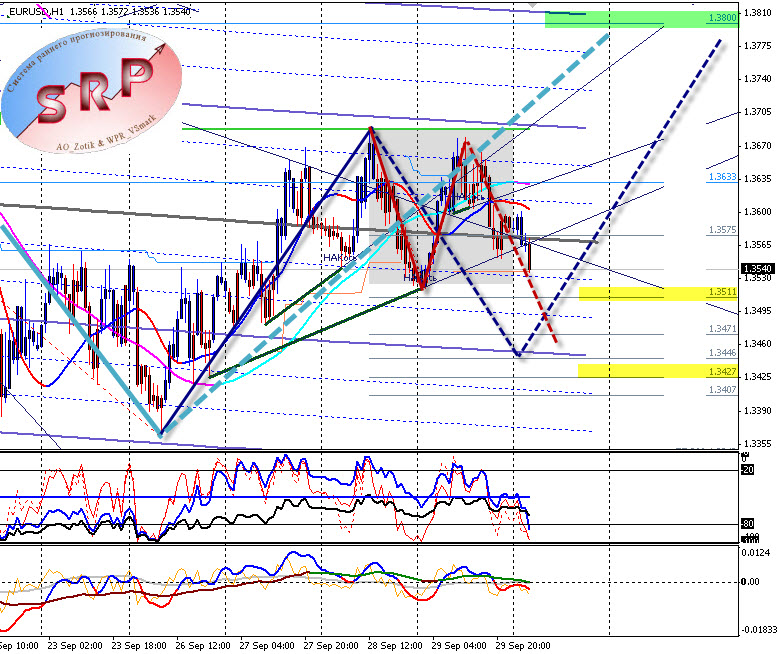
EURUSD rate:
Euro rate maintains correction to h1 level upward wave at Forex market. At this point sub-wave “c”, whose approximate targets are 1.3511 and 1.3427, can be found within correction; after this, according to the specialists of the System of Early Prediction Sub-department under the Department of Masterforex-V Trading System , upward motion will probably last at least to h4 level wave “C” 1.3800.
Rate of Chinese yuan (CNY):
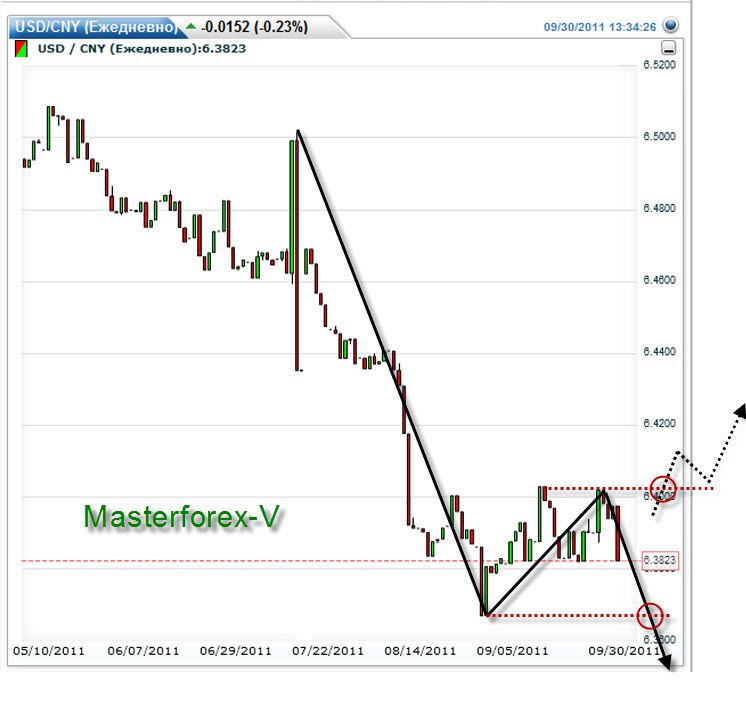
Rate of yuan is traded within the narrow flat of 6.37-6.40, according to the experts of Masterforex-V TS. Further flow of events will be connected with leaving this flat. Thus, passing the bottom line of the flat will signal that bear trend continues, represented by Daily2 level wave С, whereas passing the top line of the flat will indicate the start of Н4/Н8 level wave С, possibly represented by АВС correction structure.
The Editorial Board of “Market Leader” magazine, jointly with the experts of Forex Academy and Masterforex-V Futures Trade and Stock Exchange, holds a questionnaire in Forex forum: is it likely that consumption level will become equal in developed and developing countries during next 20-30 years?
• yes, this is a historically predetermined perspective;
• no, developed countries to resign the reins of world government;
• the world and the spheres of influences will redivided.
News
11 years ago
What should the USA learn from Russia and China?
 Edward Culchenko
Forex analyst and economic researcher specializing in macro data, sentiment shifts, and structured risk control.
Other commodities
Palladium Metall Price Analysis: Uptrend Holds as $1,930 Head & Shoulders Risk Builds
13 Feb 2026, 12:02 PM

Silver
Silver Price Rally Pauses Short of $148 Target Despite Market Backwardation
08 Feb 2026, 12:02 PM


