Tatiana Kashyrskaia
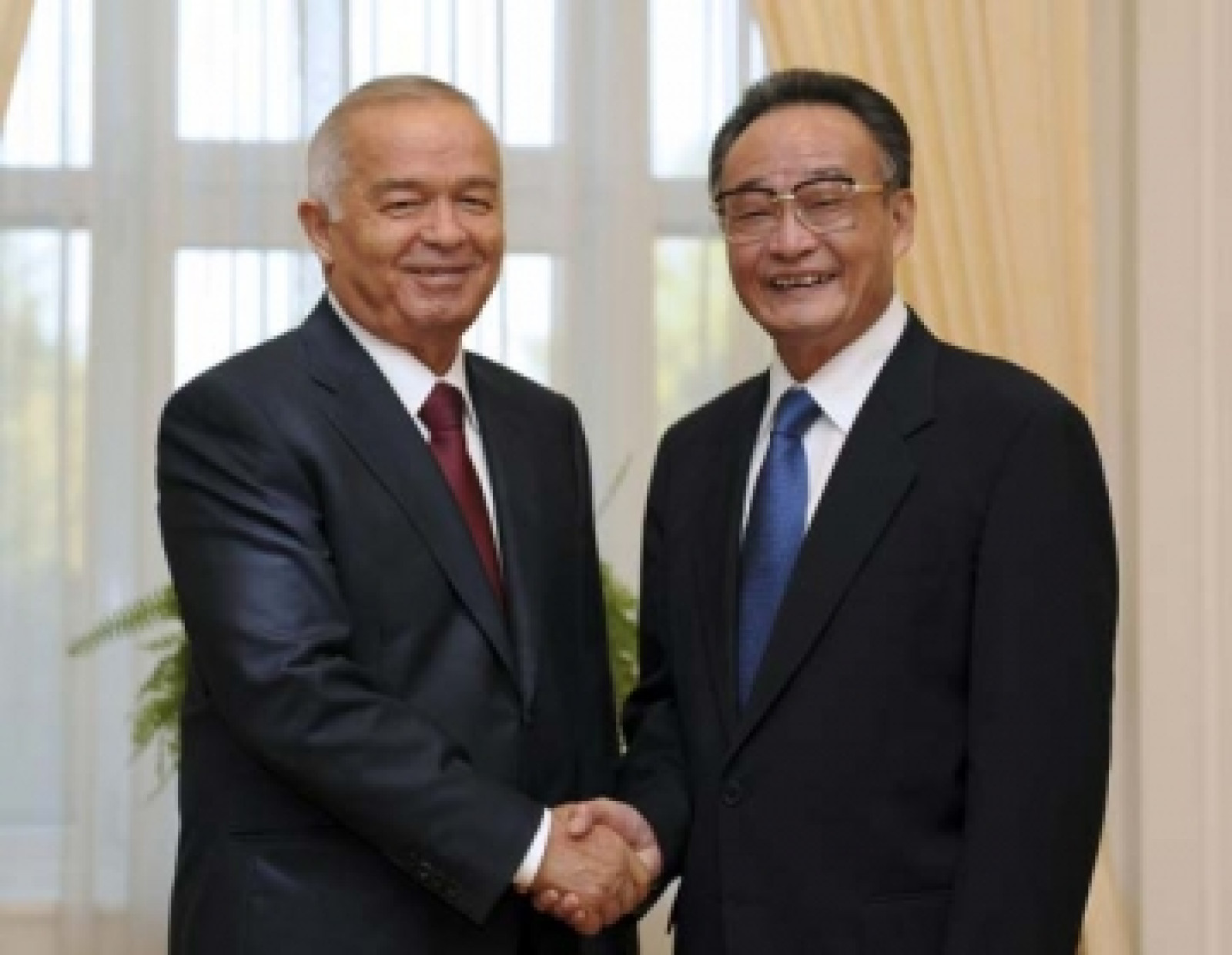
News from Uzbekistan. China continues expanding its presence in Middle Asia. Last week, the dynamically developing cooperation between Beijing and the region's states reached new highs.
The parliamentary delegation of the People's Republic of China led by Chairman of the Standing Committee of the People's National Representatives of China U Bango visited Uzbekistan that had long claimed the status of an informal leader in the region.
In fact, it is support of the powerful Asian neighbor that Tashkent's claims are built on for not only independent policy-making, but also a role of kind of 'the first fiddle' in modern Middle Asia. Any diplomatic approaches between China and Uzbekistan are perceived with high tension both in Washington and Moscow. What novelties should be expected by investors in the countries' gas market? Are there any positive things that cooperation can be built on?
How did bilateral relations evolve?
In April this year, President of Uzbekistan Islam Karimov had an official visit to the capital of the People's Republic of China to meet Chairman Hu Jintao. The two countries' leaders made a couple of arrangements on many issues of economic and political cooperation.
According to experts of the Land Association of Uzbekistan within the , it is their implementation that documents signed on 21 September in Tashkent were intended to promote. The state visit of Uzbekistan's leader to China resulted in signature of over 20 important documents and execution of contracts implementing projects totaling over $3.5 bn. 'The goal of my visit is to put the consensus reached by heads of the states in practice and promote Chinese-Uzbek relations to a new level', - said U Bango:
1. What did U Bango offer? In his speech before the Supreme Council of Uzbekistan, the Chinese speaker put forward thee proposals: firstly, to expand strategic interaction based on a deeper political mutual trust; secondly, establish closer economic links based on mutual benefit and the 'win-win' principle; thirdly, develop the ability to counteract real threats based on stronger cooperation in the area of security. Therefore, China claims both economic and political influence.
2. What was signed? During his visit to Uzbekistan U Bango held negotiations with the Chairman of the Upper Chamber of the country's parliament, Ilgizar Sobirov. They resulted in the signature of a few crucial official documents:
■ the Memorandum of Cooperation between the Senate of Oliy Majlis of the Republic of Uzbekistan and the Standing Committee of the People's National Representatives of the People's Republic of China. This document was intended to further strengthen the legal foundations of practical cooperation. Obviously, Uzbekistan and China plan to only expand mutual contacts, primarily in the economic area. This is what a solid legal basis is required for;
■ numerous documents on cooperation on technical and economic issues, oil and gas, chemical and mining sectors.
The New Silk Road or what should investors expect?
Uzbekistan is given a key role in building China-Middle Asia gas pipeline which starts on the border of Turkmenistan and Uzbekistan and which has already been baptized as 'the modern Silk Road'. It should connect one of the largest natural gas exporters (Turkmenistan) with its major consumer - China:
■ the length of the new gas pipeline exceeds 1,800 kilometers, including a little shy of a third, or 529 kilometers of pipes, to cross the territory of Uzbekistan;
■ in December 2009 the first branch of the gas pipeline started operating, and in October 2010 gas started flowing from Middle Asia to China through two branches;
■ this gas pipeline is expected to achieve a throughput of up to 30 bn. cubic meters of 'blue fuel'. The volume of gas transported to China over the past 640 days of operation (as of 1 September) reached 14.7 bn. cubic meters;
■ the gas pipeline is built by CNPC, a Chinese company. U Bango visited his compatriots that are now working in Uzbekistan.
Chinese-Uzbek economic cooperation.
Trade turnover. The volume of bilateral trade more than quadrupled over the past years and exceeded $2 bn. in 2010. As of this date the trade turnover between China and Uzbekistan has reached $2.4 bn. It was in the first 6 months of this year alone that it grew 6.5% as compared to the same period last year. The two states are going to expand the volume of bilateral trade to $5 bn. by 2015. This is what U Bango said in his speech in Tashkent.
Investments. The volume of Chinese investments in Uzbekistan's economy is already at $1.65 bn. Today over 350 enterprises with Chinese capital are actively operating in a variety of sectors of this Middle-Asian Republic. There were only 83 of such companies in Uzbekistan in 2005, about 200 in 2010 and 350 now.
The Editor's Office of Market Leader in conjunction with experts of the Masterforex-V Trading Academy holds a survey at the trader and investor forum: in your opinion, will China manage to force all its competitors out of Middle Asia?
· yes, ultimately;
· no, Russia has traditionally strong positions there;
· probably, only in some Republics.
 Tatiana Kashyrskaia