Vlad Demochko
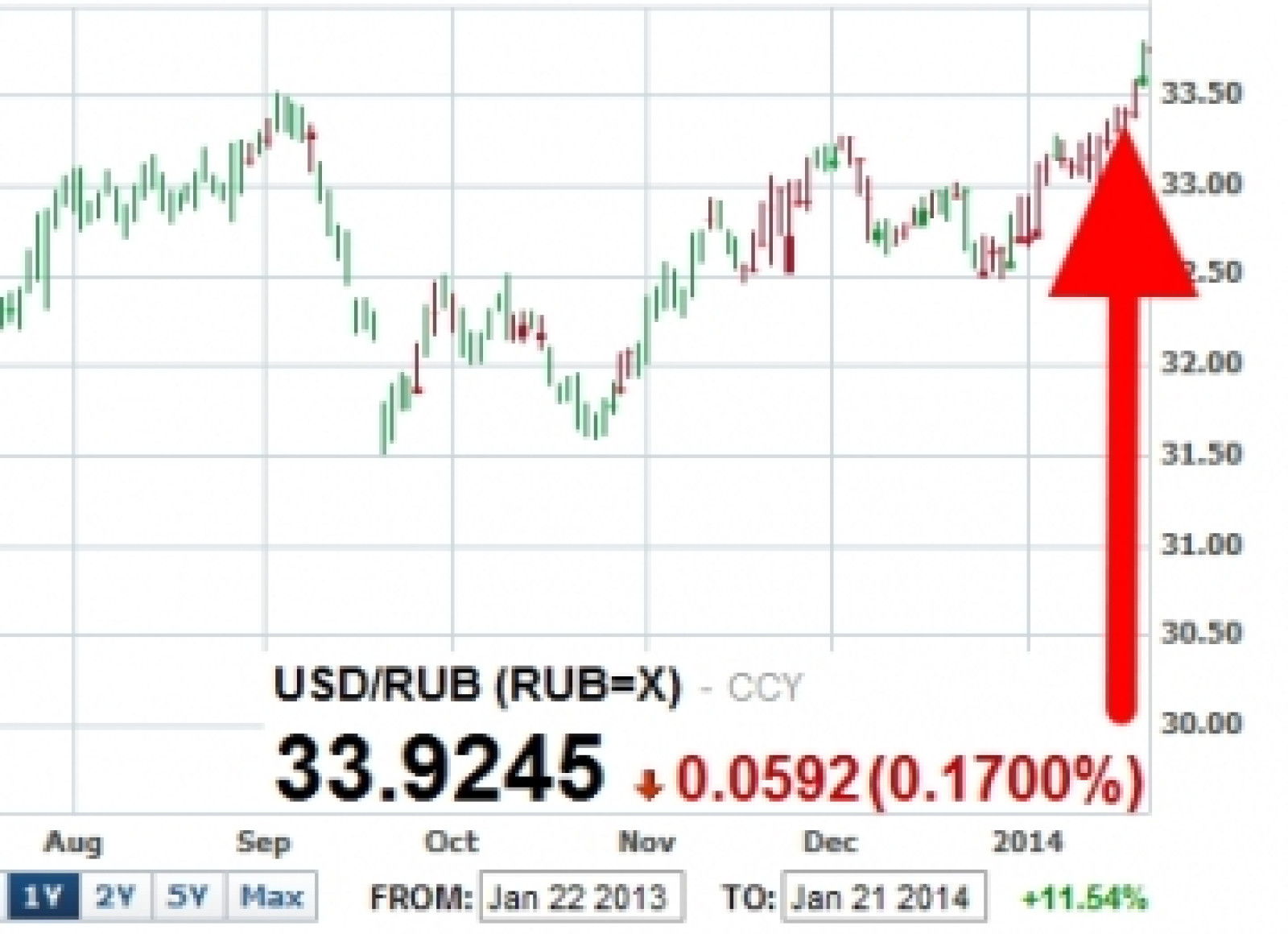
As of January 21st, 2014, the Russian Ruble declined by nearly 0,30RUR against USD. Therefore, the USDRUR exchange rate hit the highest level in almost 5 years (since spring 2009). Fundamentals had played a dirty trick on the Russian currency. In particular, the Russian central bank conducted a series of stress tests including difficult scenarios like 30% currency devaluation.
What are the prospects of the Russian Ruble? May it continue declining versus the US Dollar? Let’s ponder on these questions together with Masterforex-V Academy.
USDRUR at New Highs
According to the data provided by the Moscow currency exchange, the USDRUR exchange rate increased by 0,20RUR up to 33,8RUR per 1 USD. At the same time, EURRUR increased by 0,35RUR up to 45,8RUR per 1EUR. At the same time, the EURUSD exchange rate was at 1,366.
The current week started for the Russian Ruble with a decline. The US Dollar is being supported by the Fed’s decision to taper the existing monetary policy. Meanwhile, uncertain stock and commodity markets leep pressing on the Russian currency. The Euro currency is currently being supported by stronger economic figures coming from Germany, which is the eurozone’s economic locomotive.
Experts on USDRUR
According to the trading experts of Masterforex-V Academy, Russia is expected to see further weakening of economic figures in 2014. Apparently, if coupled with the Fed’s intension to keep tapering QE3, we may well see further devaluation of the Russian Ruble against the US Dollar.

As expected, USDRUR resumed the rally after a short-term retracement. The price is currently forming an ABC pattern. The wave are indicated by the following indicators (blue arrows): АО_Zotik and WPR_Vsmark. The current week is about to see USDRUR continue the C momentum with breaking pivot 2 and the US Dollar showing more strength against the Russian Ruble.
Other bearish factors or the Russian currency include a slow pace of economic growth in Russia, higher inflation and lower oil prices with little potential to increase in the near future.
Still, the Russian central bank is the only support for the currency since it may conduct a currency intervention at any time.
 Vlad Demochko