There is no denying the fact that Japanese cars are some of the best cars in the world. According Interbrand’s Best Global Brands 2011 (the world’s 100 most valuable brands), Toyota is number 11. According to BrandZ’s Top 100 Most Powerful Brands, Toyota was the most valuable car brand in 2011 ($27,76B). Honda was the world’s 4th most valuable car brand ($19,43B).
What lies behind the success of Japan’s motor industry?
It should be noted that for a couple of decades Japan was the frontrunner of the global motor industry, thus giving birth to the so-called “Japanese era of automobile production”.
The Japanese are considered some of the best car manufacturers in the world, whether it is a sports car, a land rover or even a truck. The quality is high while the costs are often relatively low.
Japanese cars are masterpieces: outstanding performance, breathtaking design, safety and affordable prices. That is what makes them stand out in a crowd. Japanese cars are vehicles and luxury items at the same time.
Everything used to be fine but in 2011 luck turned its back on Japanese car manufacturers. 2011 was the unluckiest year for them. The production declined by 13% while the rest of the global car manufacturing industry recovered from the crisis and started growing. Obviously, the major reason was a series of devastating earthquakes and tsunamis, which caused the Fukushima nuclear disaster. Floods in Thailand, stronger yen and the eurozone crisis also contributed to the slowdown.
So, let’s consider the prospects of the Japanese motor industry to find out whether it is worth investing in. The experts of offer their outlook of Japan’s 4 car giants - Toyota Motor Corp., Honda Motor Co., Mitsubishi Motors Corp., Mazda Motor Corp.
Sales Volume
The difficult situation Japan’s motor giant found themselves in during 2011 couldn’t but affect the sales volume of all the Japanese car manufacturers.
Toyota Motor Corp. This is the world’s leading car manufacturer in terms of market capitalization. It owns 52 manufacturing facilities around the world with over 300K employees.
In 2011 Toyota sold 7,95M autos, which is a 5.6% decline as compared to 2010. As a result, Toyota yielded to General Motors and Volkswagen, thus becoming number 3. According Akio Toyoda, CEO of Toyota Motor Corp, when it comes to being number 1, it is not only about sales. Toyota’s major focus is quality. Despite the overall decline, Toyota consolidated its position in Asia and Russia (In Russia it sold 51% more cars than in 2010).
This year Toyota is planning to increase its sales by 21% up to 9.58M cars, thus regaining the position of the world’s number one in terms of car sales.
According to the experts of , the chart of Toyota Motor Corporation’s stock (below) shows the following state of affairs: Technically, the price is forming an upswing – wave A/B of a major wave level. The closest level of resistance is $85.49. Once the price breaks and consolidates above it, it will get an opportunity to exceed the $93.90 high, which was set in early 2011. If the price breaks below $63.27, the downtrend will resume in the form of wave C of a major wave level.

Honda Motor Co. It is Japan’s 3rd largest car manufacturer. It owns over 100 manufacturing facilities in 33 countries around the world. The company employs over 145.000 people.
2011 was especially unlucky for Honda. The company reduced its production volume by 20% down to 2.91M cars, thus going 8 years back.
It is expected that at the end of this financial year (ends on March 31st) Honda’s sales volume may drop by 12.2% down to $102B. The company’s experts are sure that the misfortunes are temporary. They promise to increase the company’s car sales up to 4M cars next financial year for the first time in history.
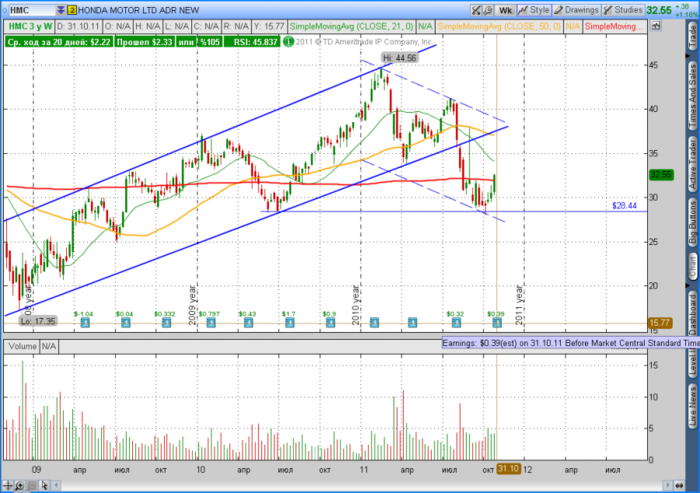
According to , if to look at the chart of HONDA MOTOR CO’s stock, one will see the price forming an upswing - wave A/B of a major wave level. After consolidating above the MF sloping channel, the next major level of resistance is 32.95. The downtrend will resume only if the price breaks below the MF sloping channel and pivot (with a full-grown FZR).
Mitsubishi Motors Corp. This is another major Japanese car manufacturer. It owns manufacturing facilities in 32 countries around the world, thus employing some 60.000 people.
Last year Mitsubishi reduced its production volume by 2.8% down to 1.14M cars. By the way, this is the first reduction since 2009. The export to Asia declined by 7.4% while the export to the US and Europe increased by +12,5% and +16,6% correspondingly.
The company anticipates gradual sales growth in 2011-2013 mainly due to emerging markets, including Russia.
MITSUBISHI MOTORS CORPORATION’s stock keeps developing its downtrend. Once the price breaks below 88,00 - the local low - the downtrend will probably reach 82,00. A rally can be considered only after the price breaks above the MF pivot and sloping channel (as shown below):

Mazda Motor Corp. This is Japan’s 5th biggest car manufacturer. It employs some 39000 people. As opposed to other companies, Mazda have relatively few external manufacturing facilities – only 18.
Unfortunately, there is no sales stats for the 3rd financial quarter of 2011. The sales volume declined by almost 30% during the 1st quarter (this was the hardest time for Japan’s motor industry). The company is planning to increase the output up to 2M cars a year by 2016.
MAZDA MOTOR CORP’s stock is currently forming a major downswing – probably, wave C of Monthly, the experts of assume. A break below the 1.10 low will confirm the supposition. If the price breaks above the 2.14, it will trigger the bullish scenario.

Financial Stats
Toyota Motor Corp.
Over the first 9 months of the 2011-2012 financial year (ended on Dec 31st) the company’s net profit declined by 57.5% down to $2.1B. The financial year will end on March 31st. By that time, the net profit is expected to reach $2.6B, which is -51% versus last year’s performance.
Last year’s income per share was equal to $1,59 per share. This year it is expected to decline down to $0.67 per share. Over the last 9 months of 2011 the company’s proceeds declined by 10.2% down to $168B.
Honda Motor Co.
The net profit declined by 71.4% down to $1.82B over the last 9 month of 2011. The income per share declined from $0,59 down to $0.34 per share. As for the entire financial year, the company expects its income to reach $2.8B (-59.7% as compared to 2010-2011). Honda is the slowest Japanese motor company to recover its production.
Mitsubishi Motors Corp.
During the same period of time, the company’s net income reached $178,83M against $29,52M of net losses a year before. By late March the company is planning to boost its net income by 28% up to $262,51M. The income per share increased from $0,005 up to $0,03 per share.
Mazda Motor Corp.
Since Mazda exports 80% of its cars manufactured in Japan, the strengthening of the Japanese Yen keeps seriously affecting the company’s financial performance.
The company’s net loss in Q1 2011-2012 (there is no latest data) reached $510,46M versus $70,66M of profit seen a year before.
By the end of this financial year, the loss is expected to be reduced down to $243,2M.
It appears that Toyota and Honda, Japan’s major car manufacturers, have been suffering the most severe losses due to multiple force-majeure factors. However, Toyota is still Japan’s number one and one of the leading car manufacturers in the world.
Problems
According to , these are the major problems the Japanese motor industry is currently facing:
Strong Yen. The strengthening of the Japanese national currency has had a negative impact on Japan’s economy (and motor industry in particular). According to Akio Toyoda, CEO of Toyota, the country’s motor industry will collapse if the Japanese Yen keeps strengthening. The thing is that over the last few years the Japanese currency has appreciated by 25% (77 yen per dollar). Japan’s car manufacturers would feel comfortable at 100 yen per dollar. A stronger yen national currency undermines the competitiveness of Japan’s export. It is reported that the appreciation of the Japanese Yen made Japanese car manufacturers see a ¥330B income decline in the first half of 2011. On the contrary, Nissan suffered least of all because the company had moved most of its production abroad.
Other Japanese car manufacturers start moving overseas as well in order to stay competitive. Honda has already transferred 70% of its manufacturing capacity overseas and is planning to build a plant in Mexico. 50-60% of Toyota’s facilities are located abroad.
Natural disasters. Last year Japan suffered from the strongest earthquakes and tsunamis in its post-war history, which caused a nuclear disaster – the Mukushhima-1 meltdown. Due to the shortage of electricity, Japanese car manufacturers were forced to suspend domestic production.
Floods in Thailand. Honda, Toyota and Mazda have some of their plants located in Thailand. As the result of massive floods in Thailand, Honda’s local plant was flooded with hundreds of new cars. Toyota had to suspend its production due to the shortage of component parts manufactured in Thailand. The production was resumed only in late 2011.
Strategic and tactical miscalculations. We must confess that the problems that Japanese car manufacturers are currently facing are more than just some production failures. The thing is that more and more car owners start complaining about Japanese cars. For example, in late June 2011 Toyota Motor had to call back 14 million cars from around the world because of a number of defects found during the process of exploitation. This definitely affected the company’s image.
Usability. For example, Honda is over-packed with electronics, which harms its usability, not to mention the fact that such cars need constant professional care.
Pricing. It is about Toyota once again. Some experts say that it is not only about natural disasters and other negative factors. Greediness is another major factor that hinders the company’s financial performance. It has been saving on everything over the recent years. At the same time, Hondas are relatively costly.
As a result, the sales volume decline, thus causing production cuts. In particular, Mitsubishi is going to close its only manufacturing facility in Europe (which is located in Netherlands) because it accounts only for 5% of the company’s total sales. Mazda is planning to close its North American facilities this year.
Perspectives
Anyway, Japanese motor giants are not going to give up. How are they going to solve their problems and to regain their positions in the international arena?
Improving technical features. It should be noted that Japanese car are safe and comfortable. According to Consumer Reports’ rating, Japanese cars are still the best: Honda comes first, Subaru comes second. Toyota is number 10.
According to Warranty Direct’s rating, the top 3 cars are Toyota Corolla, Suzuki Alto and Honda HR-V. Honda Jazz, Mazda 2, Lexus IS, Mitsubishi Colt and Toyota Yaris continue the list.
In general, the difference between Honda and Toyota is the same as between Mercedes-Benz and BMW. Those who value ergonomics and comfort choose Toyota while those who prefer design choose Honda.
Innovation technologies. Japanese car manufacturers don’t conceal that they strive to be the frontrunners of the innovation race. The 42nd Tokyo Motor Show 2011 proved that by means of numerous futuristic concept cars. They think this will help to outpace the rivals in the near future.
These days Japanese motor brands are focused on making environmentally friendly (or green) cars. For example Toyota is recognized the “greenest” car due to creating hybrid models and electro-mobiles. In the near future the company is planning to manufacture cars with hydrogen engines. Honda is among the leaders in the sector of hybrid cars. The new crossover MazdaCX-5 corresponds to the Eruo-6 eco standards, which will take effect only in 2014.
Japanese car manufacturers are quick to react to any changes in market conditions. They restrict the production of a single model to several years. They study their customers’ feedback. And they are willing to realize their customers’ wishes.
Which is more important these days, they try to make their cars as economical as possible. For example, Toyota is planning to switch entirely to "Hybrid Synergy Drive" (its own hybrid technology) by 2030. Honda’s hybrid models are already recognized the most economical cars in Europe, America and Asia. In order to boost the sales of Honda Crosstour, the company added the models with a 2.4-liter 195-horspower fuel-saving engine. A 4-liter Honda Crosstour consumes 11.2 liters per 100km in town and 8 liters per 100km on the open road.
Japanese cars manufacturers start reorienting themselves towards emerging markets. The sales in the BRICS states are growing, especially at the expense of China, which is currently seen a car-buying fever. Chinese bought over 14 million new cars in 2011 (for comparison sake, in Germans bought around 3M cars). The amount is expected to double in 3 years. Honda and Toyota are still lagging behind GM and Volkswagen in China, However, due to Brazil and India’s markets, this year Toyota may break its own sales record set in 2007 (over 8 million cars). Russia also looks interesting to Japanese motor brands. Honda is planning to build its manufacturing facilities in Russia’s Primorye Territory. Mazda will start manufacturing its cars in Vladivostok this fall.
Moreover, considering the perspectives of Japanese car manufacturers, one shouldn’t forget about Japan’s domestic market. Japanese buy lots of cars and buy them frequently. They prefer to support domestic manufacturers.
In general, experts assume that Japanese motor giants will regain their positions this year. It is not accidental that their stocks keep growing in value.
Market Leader and would appreciate if you could participate in a survey. Please, visit the Academy’s forum for traders and investors and answer the following question:
Do the stocks of Japanese motor brand still provide good investment opportunities?