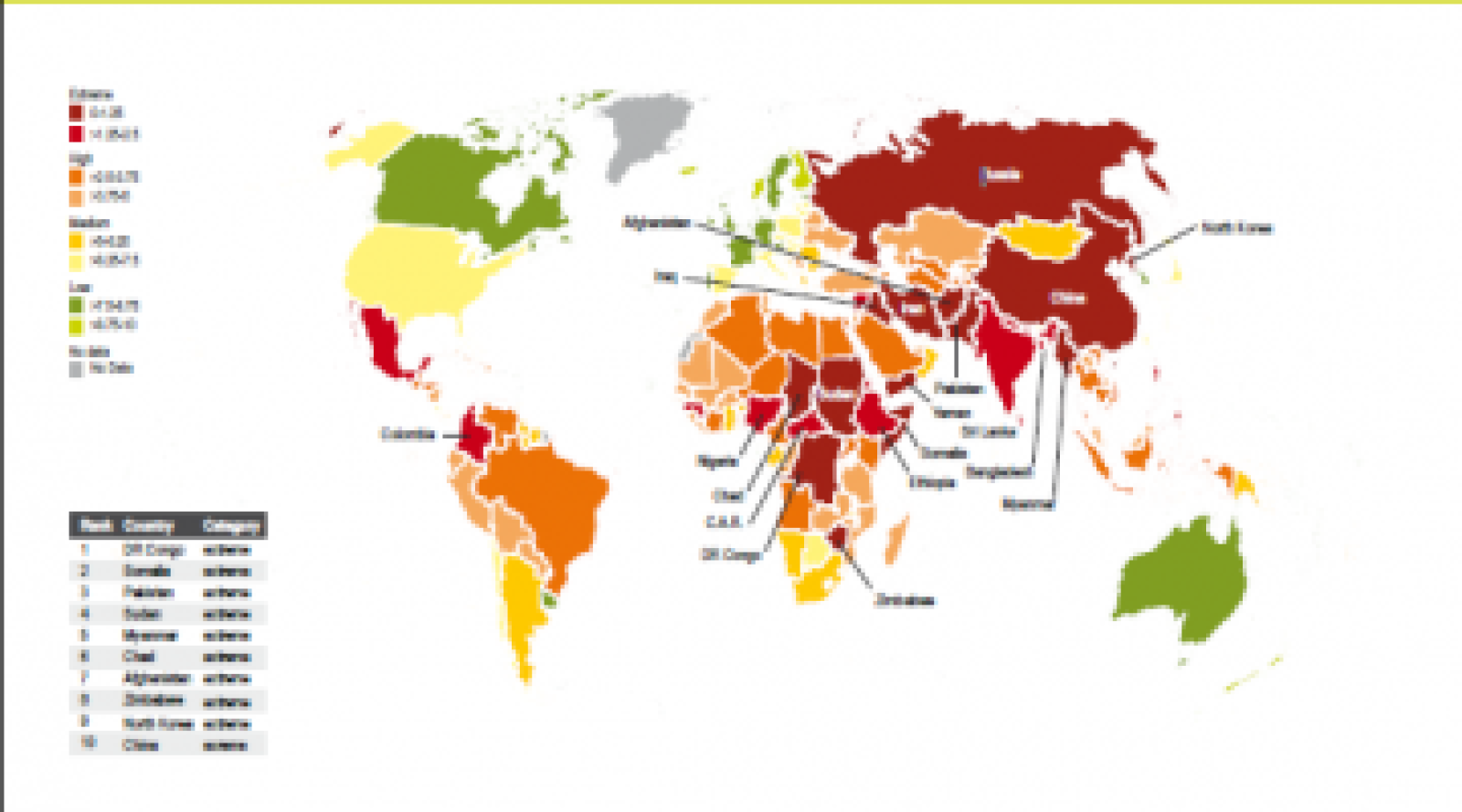
In August the analysts of Maplecroft, a British company specializing in assessing global risks, published its list of the world’s most dangerous countries - the Terrorism Risk Index. Needless to say, that this list damages the investment image of numerous countries and insults the people of those countries, especially when they do not agree with the label. What countries are in the list?
What should investors be aware of?
All in all, there are 198 states in the mentioned list, i.e. almost all the countries of the world. Basing on the degree of terrorist threats, the countries are divided into 4 groups:
The first group includes the 20 most dangerous countries: 1) Somalia, 2) Pakistan, 3) Iraq, 4) Afghanistan (again topping the ranking), 5) South Sudan, 6) Yemen, 7) Palestinian Occupied Territories, 8) DR Congo, 9) Central African Republic, 10) Colombia, 11) Algeria, 12) Thailand, 13) Philippines, 14) Russia, 15) Sudan, 16) Iran, 17) Burundi, 18) India, 19) Nigeria and 20) Israel.
The countries of the 2nd group are less risky but still dangerous: Turkey, Mauritania, Morocco, Egypt, Saudi Arabia, Kenya, Ethiopia, Nepal and Myanmar.
In the countries of the 3rd group the risk is moderate: Greece, Great Britain, France, China, Peru, Paraguay, Libya, Niger, Mali, Indonesia Tunis, Bangladesh and Uganda.
The last group (all other countries) is considered relatively safe. The safest countries are the USA, Canada, Australia, New Zealand and Germany.
What are the criteria?
The index is based on the US National Counter-terrorism Center’s Worldwide Incidents Tracking System (NCTC). The 2 major factors taken into account are the intensity (frequency) of terrorist acts and death toll. According to the data, 75% of all the terrorist attacks take place in 4 countries: Iraq (3456 dead), Afghanistan (3423), Pakistan (2163) and Somalia (1385).
What is so surprising about the index?

The Russian Association of Traders and Investors under is surprised that according to the index, Russia is considered more dangerous than war-torn Sudan. It is strange that Nigeria and Burundi are also considered safer countries than Russia (Nigeria is famous for frequent kidnapping of foreigners while Burundi has been torn by war over the last 49 years!!!).
Thailand. One of the world’s biggest tourist centers is among the 20 most dangerous countries. There are separatists in Thailand, and sometimes they used to apply terrorist methods, but the peak was seen in 2004. Now in terms of action they can be compared to Philippine, Indonesian or Peruvian guerilla warriors.
Iran. There is no terrorism (and street crimes) in this country at all. This country is in the top 20 purely because it allegedly develops its own nuclear weapon.
North Korea. The mentioned logic dictates that this country should have been placed right next to Iran. However it is recognized a safe place.
Brazil and South Africa. Strange as it may seem, these countries are among the safest, which is far from being true. In terms of criminality, these countries are some of the world’s most dangerous. In both the countries there are such areas where the police appear very seldom, supported by the local Army and armored vehicles.
Greece. In the early 2000s some armed groups of anti-globalists acted in the country. But this is not the reason to make Greece number 27 in the list of the world’s most dangerous countries.
USA. What is the difference between the US and the UK or France? None of them suffered from any major terror act during in late 2010 – the first part of 2011. Moreover, the US is number one in terms of such crimes as mass killing of people in schools and other public places, which can also be treated as a terrorist act if there is a need.
Belarus. In April 2011 Minsk, the country’s capital, was hit with a terrorist act (actually the first major terror act in the country’s history). However, it comes 104th as one of the safest countries. However, Ukraine hasn’t seen any major acts of terrorism so far but it is still number 72 (or 32 standings higher then Belarus).
What is wrong with the methodology of the index?
According to Alexander Bortnikov, Chief of Russia’s Federal Security Service, out of 169 terror acts 110 were committed in Dagestan and other areas of Northern Caucasus. However the rating considers the entire country as dangerous without taking into account that the Russian Federation is the world’s biggest country in terms of territory.
· In order to be objective it is not enough to rely on 1 source of information.
· It is obvious that in Somalia, Sudan, Iraq and other similar countries nobody can provide accurate data on terrorist activity.
· The index is not up-to-date. The terrorist acts in Norway took place on July 22nd. The index was published on August 4th. It seems that 2 weeks was not enough for the company to change the standing of Norway.
Can one trust such ratings?
In 2010 the EU developed a special code. According to it, all the rating agencies must reveal the methodology of their economic research. It would be wise to introduce such codes to all the ratings in any field without exception, especially to those that look openly amateurish and biased. Let’s consider the example of Russia. It is a superpower, a BRICS member, a nuclear state, a developing economy with great potential, the host of the 2014 Winter Olympic Games and the 2018 FIFA World Cup.
However, according to some biased ratings, Russia is:
· the world’s leader in terms of slave trade
· number 2 in terms of killing per capita
· 147th in terms of freedom of speech (mass media)
· 159th in terms of rights and freedoms
· 175th in terms of public security etc.
Obviously, such ratings look ridiculous for a reasonable person.
Market Leader and would appreciate it if you could participate in a survey. Please, visit the Academy’s forum for traders and investors and answer the following question:
Can such ratings and indexes really influence a country’s image and investment attractiveness?