Yuriy Ukazkin
The amount of building permits saw a sharp increase in May, indicating the revival of the U.S. construction sector and reassuring construction companies. Last month the year-to-year building permits index reached 8.7%, the highest value since Dec 2010. Will the U.S. housing market see price decline against the background of positive fundamental data?
Tips for investors: possible price changes in the U.S. housing market
While the increasing amount of building permits usually tells investors about the growing confidence shown by construction companies, a significant increase in the index value is mainly determined by seasonality, says Doug Roberts, Chief Investment Strategist at Channel Capital research. He notes that mid and late spring is usually the best season for construction works due to the most suitable weather conditions. April’s floods and bad weather forced most companies to postpone the planned construction works, which eventually made the index grow in May. That is why slight growth is also expected within the next 3 months. Even thought the U.S. housing market is in poor condition, its recovery started when the Federal Reserve announced another round of quantitative easing (QE2). Mr. Roberts assumes that the end of QE2 and the excessive amount of new homes may affect the U.S. construction sector in the 2nd part of 2011.
In his turn, Egorov Ivan (donneo), a housing market expert from notes that after considering the 1st (major) block of economic indicators that have direct impact on housing prices, it is possible to conclude that according to the new technical analysis developed and introduced by Masterforex-V, housing markets obey the same laws as Forex, stocks, commodities and other markets:
1. If the indicators show multidirectional movement, the price moves in a range (flat)
2. If they move unidirectionally, there is a trend in the market
3. Unidirectional FZRs (fractal-zigzag reversals) – a strong signal foreshadowing a strong market movement.
4. Housing price charts provide the main info to analyze. Building permits and construction spending are the main indicators to monitor.
5. Construction spending is a secondary indicator confirming the main chart
6. Construction is directly connected with the population’s income. That is why a construction volume increase means economic recovery.
7. Building permits are an anticipatory indicator. It is the leading housing market indicator. A n increase shows that the country’s construction industry is strong. Another important factor is that any housing market activity creates a wave effect - construction companies employ more working power in order to satisfy growing market demand.
Is there another “soap bubble” in the U.S. housing market that is going to burst?
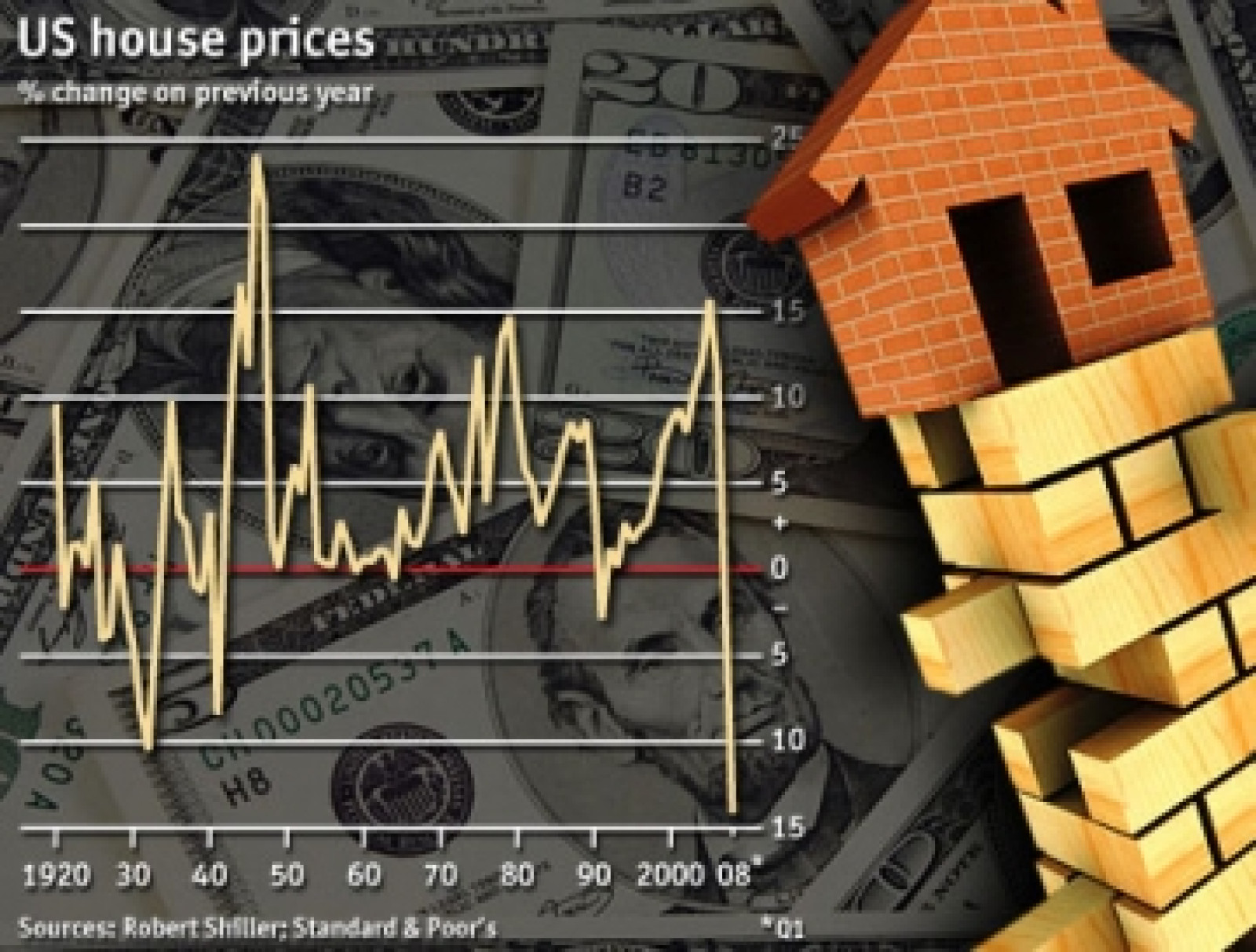
The below chart shows the soap bubble of 1995-2006 that emerged thanks to the availability of mortgage loans and was the last bullish wave. After that the market collapsed, reversing the uptrend and initiating the latest global crisis in 2008.
Building permits can help us to trace the very beginning of the crisis: the chart showed a sharp decline a year before the U.S. housing market collapsed.
According to Ivan Egorov, if to try to anticipate the future succession of events, there is high probability of another decline. The recent slight growth was provoked by the Fed Reserve’s quantitative easing and interest rate reduction. However without an economic improvement such growth cannot be considered as the crucial moment that can reverse the downtrend. This is just some kind of retracement against the major downtrend.
According to Mr. Roberts, the U.S. housing market is currently getting more stable. However, it looks more like a patient recovering from an accident. He is off the critical list now but is far from completely recovering.
The number of pending homes grew by 3.5% in May. The number of pending single-family homes reached 419000K (a 3.7% increase).

Market Leader and offer you to discuss the topic. Please, visit the Academy’s forum for traders and investors and answer the question below:
Will the U.S. housing market manage to reverse the downtrend in the short run?
· Yes, it will.
· No, it won’t.
· It will stay flat within a year.
 Yuriy Ukazkin